

Economic data and recent rate hikes are sending mixed messages about near-term expectations around inflation and a possible recession.
The continued slowdown in working hours and employees working in small businesses have deviated from previous years, possibly as a result of Decrease in holiday spending.
In past quarters, rising interest rates and economic data on inflation and employment fueled speculation that we could expect a recession in 2023. His more than 2 million employees at over 100,000 SMBs to understand how the broader economic environment has affected small businesses and their employees during the 2022 holiday season behavioral data was analyzed.
Summary of Findings: Homebase high-frequency timesheet data shows that work hours and workforces continue to slow down across most industries and major metropolitan areas.
- Our key Main Street Health Metrics (hours worked and employee hours worked) continue to decline month-over-month in December. Compared to November, the number of employees in December decreased by 3.5 percentage points on the 7-day moving average. December’s rate of decline is steeper than seen during the same period in previous years.
- Fewer workers in mid-December than mid-November in most industries, more than ever. The decline was larger than in the corresponding period in 2019, with hospitality (-7.0{ea2cba5bdf6fe62bbe85e24807814144a71e77d3ae7311fbc27a008558d1372c}) and long-term care (-4.3{ea2cba5bdf6fe62bbe85e24807814144a71e77d3ae7311fbc27a008558d1372c}) showing the largest declines. Entertainment bucked the trend with monthly increases (+0.3{ea2cba5bdf6fe62bbe85e24807814144a71e77d3ae7311fbc27a008558d1372c} vs. November), though softer than 2019 comparative levels.
- Hours worked continued to decline in the top five metropolitan areas. These declines have been a consistent trend over the last two quarters, but Chicago and Los Angeles saw the biggest declines compared to a year ago.
The percentage of employees working after the Thanksgiving holiday continued to decline, down 3.5 percentage points from the previous month. This downward trend is slightly more pronounced than that seen over the same period in previous years.
working employees
(7-day moving average; compared to January of reported year)
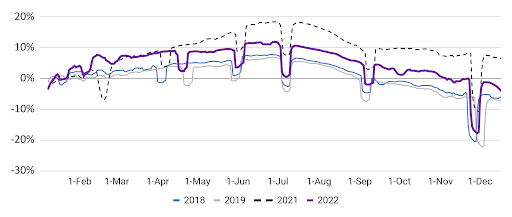
Main Street Health Index1
(7-day moving average, compared to Jan 2022)
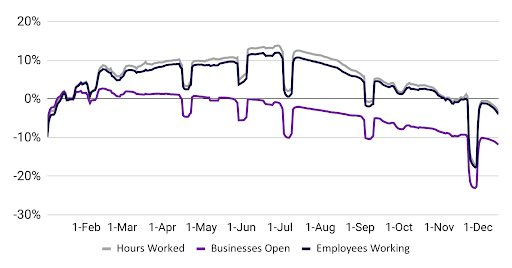
1. Significant drop due to major US holidays. A noticeable drop in mid-February 2021 coincides with a period that includes the Texas power crisis and severe weather in the Midwest. A late September plunge coincides with Hurricane Ian. Source: Headquarters data.
Most industries, except entertainment, have significantly fewer employees working the week leading up to the 2022 holiday season. Beauty & Wellness and Care are well below their corresponding 2019 levels in a shift from November data.
Rate of change in working employees
(compared to the January 2022 baseline using a 7-day rolling average)1
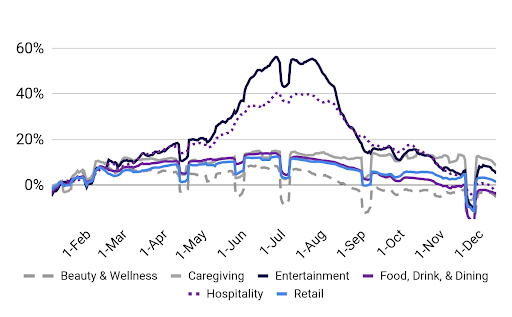
Rate of change in working employees
(Mid-December and Mid-November, using baselines of January 2022 and January 2019) 1

1. Dec 11-17 vs Nov 13-19 (2022) and Dec 8-14 vs Nov 10-16 (2019). Notable dips usually coincide with major US holidays.Source: Headquarters data
Hours worked in the top five metropolitan statistical areas (MSAs) continue to decline after the Thanksgiving holiday compared to mid-November levels, consistent with month-over-month trends. As in previous months, Los Angeles and Chicago will see significant drops from his 2021 levels.
working time
(7-day moving average; compared to Jan 2020 (pre-Corona))
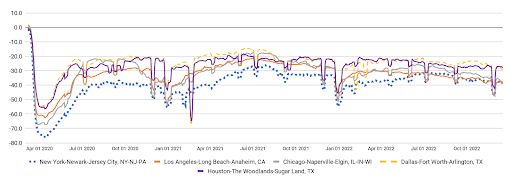
1. Significant drop due to major US holidays. A noticeable drop in mid-February 2021 coincides with a period that includes the Texas power crisis and severe weather in the Midwest. Source: Headquarters data.
For a PDF of the December report, please visit this PDF. Please cite Homebase if you use this data for research or reporting purposes.
Link to PDF: Homebase December 2022 Main Street Health Report – EOY
